
Australia: Uluru Rock Northern Territories
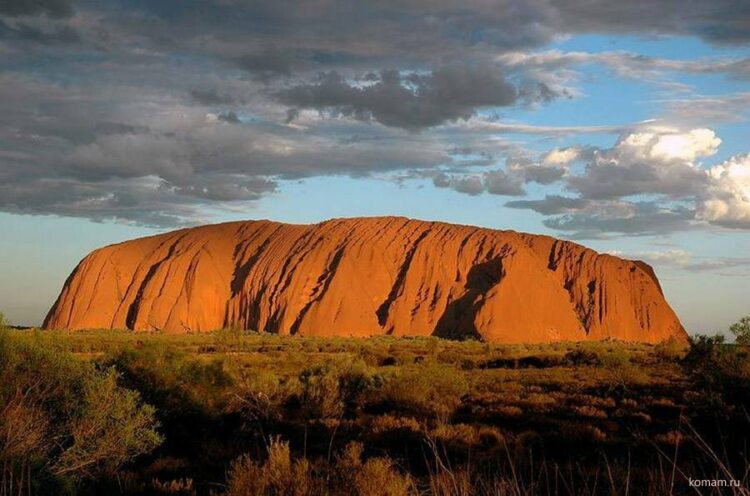
Uluru Rock, or Ayers Rock, is a 350-metre-long oval-shaped rock. Uluru (emphasis on the final syllable) is located in the heart of Australia. It is more than 3.5 km long and about 3 km wide. The foundation of the rock is carved by caves, and the caves themselves are decorated with ancient rock drawings and carvings in stone.
Once in the center of the mainland stood a mountain range, representing an island in the middle of Lake Amades. Products of rock destruction were deposited at the bottom of the reservoir, forming rock. In appearance, Uluru resembles a giant elephant lying on its side. The monolith looks completely smooth, but near the surface are clearly noticeable irregularities, cracks and lumps.

The desert microclimate is characterized by fluctuations in temperature: the nights here are cold, and the heat at noon reaches 40 degrees. The stone expands when heated and shrinks when cooled, causing it to crack. The unique mountain giant consists of red sandstone, whose special properties allow it to change color depending on the lighting during the day. At dawn, the black contour of the mountain shines, acquiring a dark purple hue. The light rises higher, and Uluru flashes purple-red, then shines pink, and by noon becomes golden. The fantastic game of color continues every day.
In the 19th century. Uluru was first seen by Ernest Giles. He marked the rock from the shores of Lake Amades, but failed to reach it. A year later, the British explorer William Goss climbed to the top of the wonder mountain. He named the stone globe Ayers Rock in honor of South Australian Secretary of State Henry Ayers. The name “Uluru” was given to the rock many centuries ago by the local natives. That word means nothing. Archaeologists suggest that the natives inhabited the areas adjacent to Uluru, another 10 thousand. years ago. Due to the knocking of the underground key and caves for hundreds of years Uluru was a refuge for the ancient tribes.

Tourists began to visit this place only in the middle of the last century, after the completion of the construction of a road through this area. Since 1985 Uluru officially belongs to the Anangu tribe, although the stone giant was leased to the government for 99 years for use as a national park. The annual rent is $75,000. plus 20% of each ticket. The locals are interested in the development of tourism and in accordance with the agreement do not prevent visiting the Uluru peak, to which their sacred path leads.


